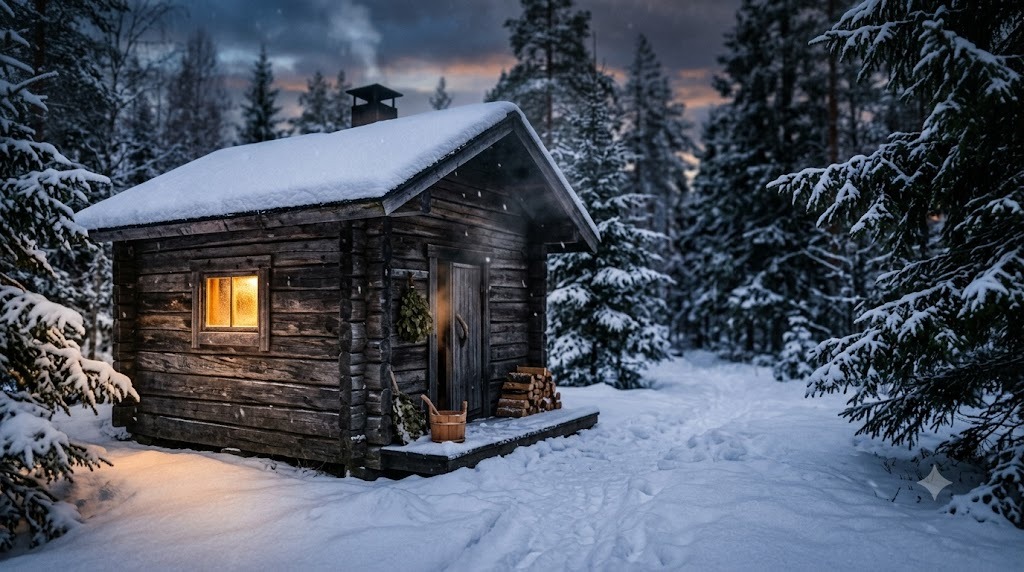
A Brief History of the Sauna
The sauna's history runs in four broad chapters: earth pits heated with fire-warmed stones, chimney-less smoke saunas, wood-burning stoves with chimneys, and the electric heaters most bathers know today. That arc covers at least two thousand years in Finland and Estonia, where the sauna was never a luxury but the household's washroom, delivery room, and quiet sanctuary. Scent ran through every era - smoke, tar, and birch first, essential oils only recently. Here is how each stage worked, and what it smelled like.
Chapter One: A Pit in the Earth
The earliest saunas were probably not buildings at all. The most widely accepted picture is a pit dug into the ground, stones heated over an open fire, a covering of skins or turf, and water thrown on hot rocks for steam. In the Finnish and Baltic region this practice is conservatively dated to around two thousand years ago, though nobody can point to a first sauna - sweat bathing itself is older still and evolved independently in many places, from the Russian banya to the Central American temazcal. What makes the Nordic-Baltic line special is continuity: the sauna never fell out of use and never stopped being ordinary.
Its scent is easy to imagine and impossible to bottle - hot stone, damp earth, woodsmoke, steam - and everything that came later is a refinement of those four notes.
From Survival to Ritual
In old Finland and Estonia the sauna was the most practical room a family owned - and the most sacred. It was warm when nothing else was, and it was regarded as the cleanest space on the farmstead, so it served as washroom, sickroom, and delivery room in one. Children were born in the sauna. The ill were carried there to rest. The dead were washed and prepared there for burial. A Finnish proverb holds that if sauna, tar, and spirits cannot help, the illness is beyond help - folklore rather than medicine, but it shows how central this one room was to life.
The Smoke Sauna Era
For most of recorded history, a sauna meant a smoke sauna - savusauna in Finnish, suitsusaun in Estonian. There is no chimney at all. A massive pile of stones is heated by a wood fire, traditionally alder or birch, for several hours. Smoke fills the room and blackens the walls and ceiling with soot; before bathing, it is vented through a small hatch, leaving behind deep, soft heat radiating from the stone mass - and a scent like nothing else, sweet-sharp woodsmoke over hot rock and old timber.
Estonia guards this chapter with particular devotion. The smoke sauna tradition of Võromaa, in the country's south, was inscribed on UNESCO's Intangible Cultural Heritage list in 2014 - not just the buildings but the whole practice, whisks and all. We explore that world, and how to echo it with oils, in Estonian smoke sauna scents.
Chimneys Change Everything
Across the 19th and early 20th centuries, metal stoves with chimneys spread through the region. With smoke routed outside, a sauna could be heated in an hour or two instead of half a day, used far more often, and built closer to - or inside - the main house. Walls stayed pale instead of soot-black. Sweden's bastu and Norway's badstue followed the same path: the same ritual in neighbouring dialects.
The ritual itself never changed: heat the stones, throw water, breathe. The rising steam has its own name - löyly in Finnish, leil in Estonian - and we unpack the word, the physics, and the etiquette in Löyly: Finnish sauna steam explained. With the smoke gone, quieter scents stepped forward: fresh spruce and pine panelling, the birch whisk (vihta or vasta in Finnish, viht in Estonian), and the tar traditionally used to preserve doors, buckets, and boat hulls - a smoky-sweet note many people still associate with old saunas.
The Electric Age
Electric sauna stoves appeared in the 1930s and became common after the Second World War, when apartment living made a wood fire impractical. Electricity carried the sauna into apartments, sports clubs, and hotels far beyond the Nordic countries. Today Finland is estimated to have over three million saunas for a population of about 5.5 million, and Finnish sauna culture was itself inscribed by UNESCO as Intangible Cultural Heritage in 2020. The technology kept changing; the ritual did not.
What electricity did take away was scent. An electric heater produces clean, neutral heat - no smoke, no resin, no tar. That blank canvas is precisely why essential oils became the sauna's modern aromatic chapter: a few drops in the water bucket give back what the chimney and the heating element removed.
What the Sauna Smelled Like, Era by Era
| Era | Heat source | Dominant scents |
|---|---|---|
| Earth pit (antiquity) | Fire-heated stones in a covered pit | Hot stone, damp earth, open-fire smoke |
| Smoke sauna | Chimney-less stone pile, heated for hours | Alder and birch smoke, soot, warm timber, birch whisk |
| Wood stove with chimney (1800s on) | Continuously fired metal stove | Spruce and pine resin, tar-treated wood, birch whisk |
| Electric (1930s on) | Electric heater | Neutral by default - scent added by choice, today usually essential oils |
Bringing the History Into Your Own Sauna
You cannot bottle a smoke sauna - true smoke is a product of fire, not of any oil - but you can gesture honestly at each era. Always add oils to the water bucket and ladle onto the stones; never drip oil onto a dry heater.
- The timber era: pine, spruce, or cedarwood echo fresh panelling and resin. Use 3-5 drops per 500 ml of sauna water.
- The birch whisk: birch oil is rare, but eucalyptus has a similar green sharpness at 2-3 drops per 500 ml - it is much stronger than the woods. Our comparison birch, pine or eucalyptus walks through the choice.
- The smoke sauna: cedarwood's dry, almost tar-like depth comes closest, especially with a drop of spruce alongside - more ideas in the Estonian smoke sauna guide.
None of this is therapy - a scent is a scent, not a treatment - but it is a genuinely pleasant way to connect a modern electric box to two thousand years of practice. For measurements and safety notes see essential oil dosage for sauna, for the full scent map see our complete guide to sauna scents, or let the scent finder quiz choose for you.
FAQ: Sauna History
Q: How old is the sauna?
A: Conservatively, at least two thousand years in the Finnish-Baltic region. Sweat bathing in general is older and appeared independently on several continents; there is no single birthplace.
Q: What is the difference between a smoke sauna and a modern sauna?
A: A smoke sauna has no chimney: the stones are heated for hours, the smoke is vented just before bathing, and the heat comes from the stone mass alone. A modern sauna uses a chimney stove or an electric heater and keeps the room smoke-free.
Q: Were people really born in saunas?
A: Yes. In rural Finland and Estonia the sauna was warm and regarded as the cleanest room of the household, so it commonly served as the delivery room well into the early 20th century.
Q: When did electric saunas appear?
A: The first electric stoves date to the 1930s and spread widely after the Second World War. They are now the most common type worldwide.
Q: Did traditional saunas use essential oils?
A: No. Historical sauna scent came from woodsmoke, tar, resinous timber, and birch whisks. Bottled essential oils in the löyly water are a modern refinement - and only genuine essential oils belong there; we explain why perfume-type products do not in can fragrance oils go in saunas.