Description
Camphor essential oil is the sharpest instrument in the sauna cabinet - a piercing, crystalline oil steam-distilled from the wood of the camphor laurel (Cinnamomum camphora), an evergreen tree native to China, Taiwan and southern Japan. Camphor laurels can live for a thousand years, and the oil is traditionally distilled from the chipped wood, roots and branches of trees at least fifty years old. During distillation, camphor crystals literally form in the condenser - a white, waxy solid so aromatic that a single flake fills a room. The crude distillate is then fractionated into white, brown and yellow grades. Only white camphor is suitable for aromatic use; the darker fractions carry high levels of safrole, a compound you do not want near your skin or lungs. Every bottle we sell is 100% pure white camphor, and nothing else.
Few scents carry this much history. Camphor was burned in temples across Asia for millennia, carried west along the spice routes, and at times valued by medieval apothecaries above its weight in silver. Generations of Europeans knew its scent from wooden chests, winter balms and linen cupboards - a cultural memory that makes it striking in the sauna: one breath and the association is instant, ancient and unmistakably clean.
Scent Profile
Camphor does not whisper. The opening is an icy, penetrating blast - crystalline, medicinal and almost mineral in its cleanness, close to eucalyptus but colder, drier and more austere. Beneath the chill sits a faint woody-green note from the laurel wood, but the overwhelming impression is of pure, cold air, like inhaling over a frozen lake. On the scent compass above, camphor sits at the far cooling, clarifying end of our twenty-four-oil range. It is a top note through and through: it lifts fast, dominates immediately and fades sooner than resinous oils, leaving the air feeling scrubbed. If eucalyptus is a cool forest breeze, camphor is the arctic front behind it.
In the Sauna
Camphor belongs to the very strong tier of our sauna dosing guide, alongside oregano. That means a ceiling of 1-2 drops per 500 ml of water - and honestly, one drop is the right starting point. This is an oil for experienced sauna users; if you are new to sauna aromatherapy, begin with a milder oil from our complete guide to sauna scents and work your way here.
- Fill the bucket: Pour about 500 ml of clean, warm water into your sauna bucket or ladling bowl.
- Dose with restraint: Add 1 drop of camphor oil - 2 at the absolute maximum, no matter how seasoned your nose is.
- Stir well: Essential oils do not dissolve in water, so swirl the ladle just before each pour to disperse the droplets.
- Pour gently: Ladle a small amount over the hot stones. Never drip pure oil onto the stones - undiluted oil can flash-burn and produces harsh, overwhelming vapour.
- Keep sessions short: Two or three modest pours per session is plenty; ventilate the sauna well between rounds.
- Know who should sit this one out: Skip camphor entirely if you are pregnant or nursing, if children will share the sauna, or if anyone present has asthma or epilepsy - see the safety section below.
Used this way, camphor produces the most bracing löyly in our range: a sharp, cold-feeling wave through the hot air that makes deep, slow breathing almost involuntary. Many regulars save it for the final round - not as any kind of therapy, simply because the sensation is unmatched. For the full ritual and troubleshooting, see our dedicated camphor sauna guide.
At Home
Outside the sauna, treat camphor with the same respect. In a diffuser, use just 1-2 drops, well below the standard 3-5 drop range - that is plenty even for a large room, in short 15-20 minute intervals with a window cracked open. Never diffuse camphor in a room where pets are present or where a child sleeps.
For a body or massage oil, camphor is the exception to our usual 2% rule: keep it to a maximum of 1% - about 1 drop per 5 ml (a teaspoon) of carrier oil such as jojoba or sweet almond. Camphor has been a traditional ingredient in chest and muscle rubs for generations, and a 1% blend gives that familiar cooling sensation on tired shoulders - a scent experience, not a treatment for pain or any medical condition. Patch test first, keep it away from broken skin, and never apply it near a child's face.
We do not recommend camphor for linen sprays or pillow use - it is too penetrating for close-range, all-night exposure; gentler oils like lavender do that job far better.
Blending Guide
Camphor dominates, so successful blends use it as a cold accent, never as the base - one drop of camphor to one drop of partner oil, 2 drops in total per 500 ml of sauna water. All partners below are from our twenty-four-oil range.
| Partner Oil | Suggested Ratio | The Mood It Makes |
|---|---|---|
| Eucalyptus | 1 drop eucalyptus : 1 drop camphor | Arctic steam - the coldest, most wide-open breath in the house. The classic pairing. |
| Peppermint | 1 drop peppermint : 1 drop camphor | Pure ice - menthol chill stacked on camphor's crystalline edge. For heat-lovers only. |
| Pine | 1 drop pine : 1 drop camphor | Winter forest - resinous warmth underneath a frosty top note, like snow on spruce boughs. |
| Lavender | 1 drop lavender : 1 drop camphor | Softened steel - lavender rounds off the medicinal edge into something calm and clean. |
| Lemon | 1 drop lemon : 1 drop camphor | Polished bright - citrus sparkle over cold clarity; the freshest-smelling sauna imaginable. |
Key Characteristics
| Feature | Description |
|---|---|
| Aroma Profile | Piercing, crystalline and intensely cooling, with a faint woody-green base. A fast-lifting top note. |
| Intensity | Very strong - the most potent oil in our range. Sauna dose 1-2 drops per 500 ml, never more. |
| Composition | 100% pure Cinnamomum camphora (white camphor) essential oil. No brown or yellow fractions, no synthetics. |
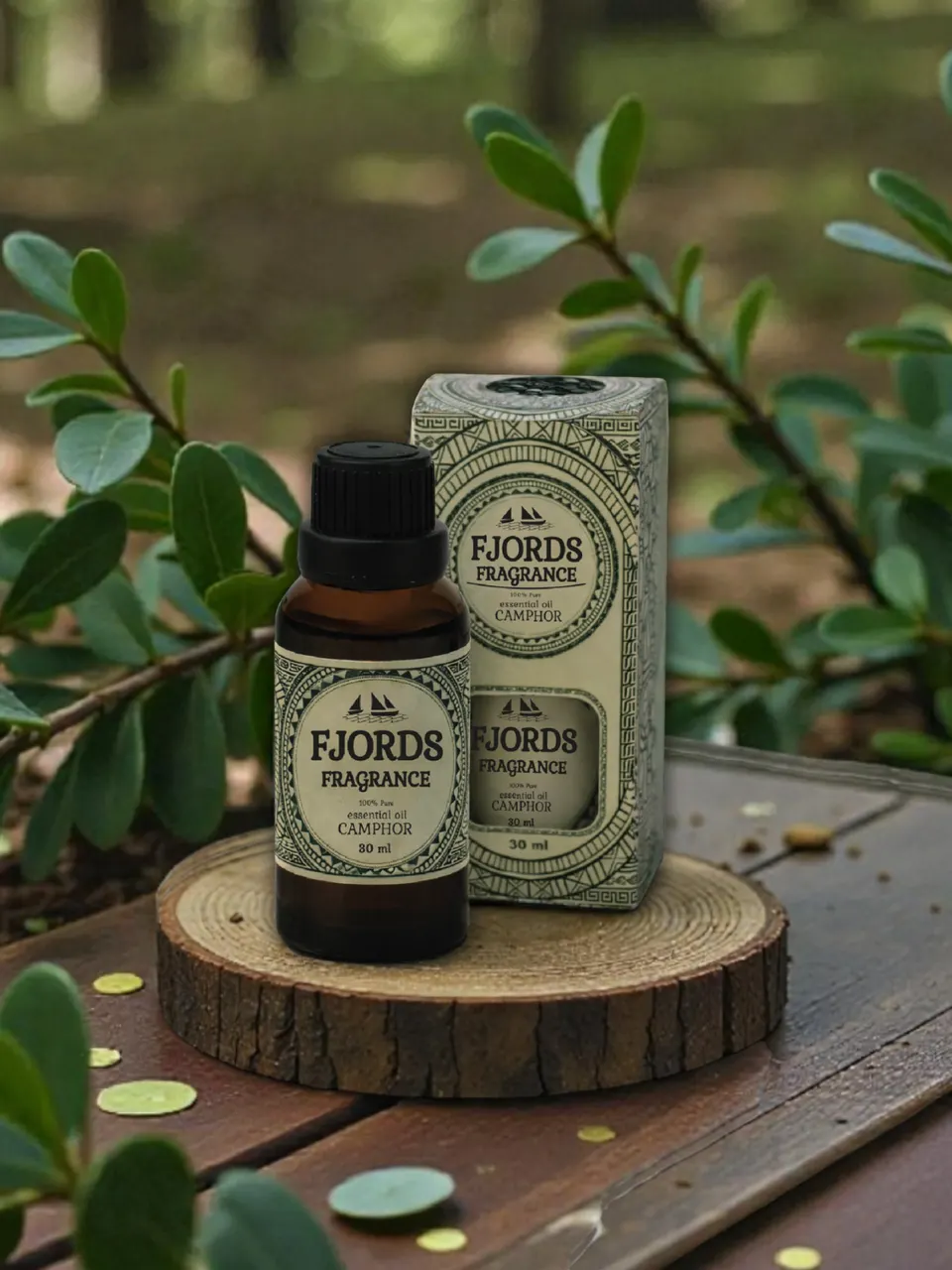
| Volume | 30 ml in UV-protective dark glass with a dropper cap. |
| Origin | Responsibly sourced from China, Japan and Taiwan. |
| Shelf Life | 3-4 years unopened; best within 2 years of opening. |
Storage & Quality
Camphor oil is chemically robust - its 3-4 year shelf life is among the longest in our range - but it is also highly volatile, so a loose cap will cost you oil and aroma faster than oxidation ever will. Store it tightly closed, upright, in a cool and dark place, and always out of reach of children and pets; the dropper cap slows accidental pouring but is not child-proof. Quality-wise, insist on white camphor from any supplier: ours is 100% pure white-fraction Cinnamomum camphora, free from synthetic additives and batch-checked to be the clean, safrole-free grade and nothing darker.
Safety Information
Camphor demands more caution than any other oil we sell. Please read this section before first use.
- Never ingest. Camphor is toxic when swallowed - even small amounts can cause serious harm. Aromatic and well-diluted topical use only.
- Keep away from children. Do not use camphor in a sauna or room shared with children, and never apply camphor products near a child's face or chest. Store the bottle where children cannot reach it.
- Keep away from pets. Camphor is considered toxic to cats and dogs - as are many essential oils, including lavender and tea tree. Do not diffuse it in spaces your animals use.
- Not during pregnancy or nursing. Skip camphor entirely during pregnancy and while breastfeeding.
- Epilepsy and asthma. Camphor is not recommended for people with epilepsy. If you have asthma or another respiratory condition, talk to your doctor before using it - strong vapours can be a trigger for some people.
- Dilute for skin. Maximum 1% concentration in a carrier oil, patch test first, and never apply to broken or irritated skin. Even diluted, it may irritate sensitive skin.
- Never pour pure oil on hot stones. Undiluted oil on sauna stones is a fire risk and releases harsh, overwhelming vapour. Always dilute in at least 500 ml of water.
- White camphor only. Brown and yellow camphor contain toxic safrole and have no place in aromatherapy.
A final word of honesty: camphor is traditionally valued for its clearing, cooling character, but we sell it as a scent - a remarkable one - not as a treatment for congestion, pain or anything else. For any health question, consult a qualified specialist.
Frequently Asked Questions
Q: What is the difference between white, brown and yellow camphor oil?
A: They are fractions of the same distillate. White camphor is the light, safrole-free grade used in aromatherapy; brown and yellow camphor contain high levels of toxic safrole and should never be used on the body or in the air. Our oil is 100% white camphor.
Q: How many drops of camphor oil should I use in the sauna?
A: 1-2 drops per 500 ml of water, starting with just one. Compare that with 3-5 drops for mild oils like lavender or pine. More is never better here.
Q: Is camphor essential oil safe to ingest?
A: Absolutely not. Camphor is toxic when swallowed, even in small amounts. It is strictly for aromatic and heavily diluted topical use; store the bottle out of reach of children.
Q: Can I use camphor oil around children or pets?
A: No. Camphor is not suitable for young children in any form - sauna, diffuser or skin - and it is considered toxic to cats and dogs. Use it only where neither are present, and ventilate afterwards.
Q: Is camphor a good first sauna oil for beginners?
A: We would steer you elsewhere first. Camphor is the most potent oil in our range and easy to overdose for an untrained nose. Start with eucalyptus or pine, then return once one drop's worth of steam holds no surprises.
Q: Does camphor oil help with colds or congestion?
A: Camphor has been used in traditional chest rubs for generations, and many people find its cooling sharpness comforting. But it is a scent, not a treatment - it does not cure or treat any condition, and people with asthma should be especially careful with strong vapours. For health concerns, consult a doctor.
Q: Can I drip camphor oil directly onto the sauna stones?
A: Never. Pure oil on hot stones can ignite and produces acrid, overpowering vapour. Always add the drops to at least 500 ml of water, stir, and ladle gradually.
Q: How is camphor different from eucalyptus oil?
A: They are cousins in character, but camphor is colder, drier and more assertive drop for drop - hence its 1-2 drop sauna dose against eucalyptus's 2-3. Eucalyptus reads as a green forest breeze; camphor as pure arctic air. Blended 1:1, they make our favourite deep-breathing steam.