Description
Clary sage essential oil is steam-distilled from the flowering tops and leaves of Salvia sclarea, a tall biennial herb in the mint family. The plant spends its first year as a modest rosette of large, wrinkled leaves, then in its second summer sends up dramatic, metre-high spires of lilac, pink, and cream flowers. Clary sage is native to the northern Mediterranean basin and parts of Central Asia, but most of the oil produced today comes from cultivated fields in southern France, Bulgaria, and southern Russia - the same regions our oil is sourced from, depending on the year's harvest.
The name carries a small piece of medieval history. "Clary" derives from the Latin clarus, meaning clear: herbalists of the Middle Ages knew the plant as "clear eye" and used its mucilage-coated seeds to sweep dust and grit from the eye. In Germany it earned the name muscatel sage, after wine merchants found that an infusion of its flowers made ordinary Rhine wine taste like expensive muscatel. Modern perfumery still leans on the plant heavily: sclareol, a compound found in clary sage, is the industry's main natural starting point for the amber-type fixatives that anchor countless fine fragrances.
Chemically, the oil is dominated by linalyl acetate and linalool - the same soft, rounded pair at the heart of lavender - supported by earthier trace compounds that make clary sage noticeably deeper and muskier than its famous cousin. It has long been a fixture of European aromatherapy and is traditionally valued as an evening oil: the one you reach for when the day is done and the sauna is already warm.
Scent Profile
Honesty first: clary sage is not a conventionally pretty oil, and that is exactly why people fall for it. The opening is sweet and herbaceous, but closer to dried herbs than to a fresh-cut garden - think black tea leaves, hay warmed by the sun, and a distinctly nutty, almost wine-like note. Underneath sits something soft and ambery, faintly musky, with a bittersweet edge that stops the sweetness from ever turning sugary. As the scent compass above suggests, it lives in warm herbal territory rather than anywhere fresh or citrusy.
Heat changes it. On the sauna stones the tea-and-hay side steps forward and the steam turns the whole room gently rustic, like a herbalist's drying attic. In a diffuser at room temperature the muskier amber base gets more time to unfold. If lavender is a freshly made bed, clary sage is a candle-lit room at the end of a long day.
In the Sauna
Clary sage reads as medium-strong on the nose, and in the sauna we dose it like a strong oil: a little carries a long way in hot steam.
- 1. Fill your bucket. Start with about 500 ml of warm water in your sauna bucket or a smaller ladle bowl.
- 2. Add 2-3 drops. That is the full dose for 500 ml of water. If the scent is new to you, begin with 2 drops - you can always add the third next round.
- 3. Stir well. Essential oils do not dissolve in water, so swirl the water just before each pour to break the oil into fine droplets.
- 4. Pour a little at a time. Ladle small amounts over the hot stones and let each wave of steam settle before the next. The aroma should feel like a warm layer in the air, never a wall.
- 5. Never pour pure oil onto the stones. Undiluted oil scorches on contact, which wastes the oil, risks flash ignition, and fills the room with acrid smoke instead of scent.
Clary sage suits slow, quiet, end-of-day sessions best - a beautiful match for the last löyly of the evening. Our sauna dosing guide explains how these amounts scale for larger buckets and stronger preferences, the complete guide to sauna scents shows where clary sage sits among all twenty-four oils in the range, and the dedicated clary sage guide goes deeper into this one oil.
At Home
- Diffuser: Add 3-5 drops to the water reservoir. Clary sage is a natural fit for the last hour before bed, when its dry, tea-like warmth reads as a signal to slow down.
- Body oil: For skin use, keep the dilution around 2 percent - roughly 4 drops per 10 ml of a carrier oil such as jojoba or sweet almond. Patch test on the inner forearm before wider use.
- Linen spray: Stir 10-15 drops into 20 ml of high-proof unscented alcohol and top up to 100 ml with water in a mist bottle (shake hard before every spray, since oil and water separate) and mist lightly over bedding or towels, not directly onto skin.
- Bath: Never drip essential oil straight into bathwater - it floats and can sit on the skin undiluted. Mix 3-4 drops into a tablespoon of carrier oil first, then add to the water.
Blending Guide
Clary sage is one of the most cooperative blenders in the range: its dry, nutty warmth rounds off citrus, deepens woods, and gives florals a grown-up edge. The ratios below are starting points, given as clary sage to partner.
| Partner Oil | Suggested Ratio | The Mood It Makes |
|---|---|---|
| Lavender | 1:2 | The classic wind-down pairing - two linalyl-acetate oils folding into one soft, quiet scent made for the evening sauna. |
| Bergamot | 1:2 | Bright and gently optimistic; the citrus lifts clary sage's tea notes without erasing their warmth. |
| Cedarwood | 1:1 | Dry woods over dry herbs - a grounded, log-cabin warmth that suits long winter sessions. |
| Pine | 1:2 | A Nordic forest sauna: resinous freshness up top, herbal depth underneath. |
| Patchouli | 2:1 | Deep, earthy, and faintly sweet - the most meditative blend on this list. |
| Lemon | 1:2 | A clean herbal-citrus lift that makes clary sage feel lighter and more daytime-friendly. |
Every partner above belongs to our twenty-four-oil range - you can explore the full collection in the shop.
Key Characteristics
| Feature | Description |
|---|---|
| Aroma Profile | Sweet, nutty, and richly herbaceous, with warm tea, hay, and soft amber undertones. |
| Intensity | Medium-strong - warm and enveloping; dose like a strong oil in the sauna (2-3 drops per 500 ml). |
| Composition | 100% pure Salvia sclarea essential oil, steam-distilled from the flowering tops and leaves. |
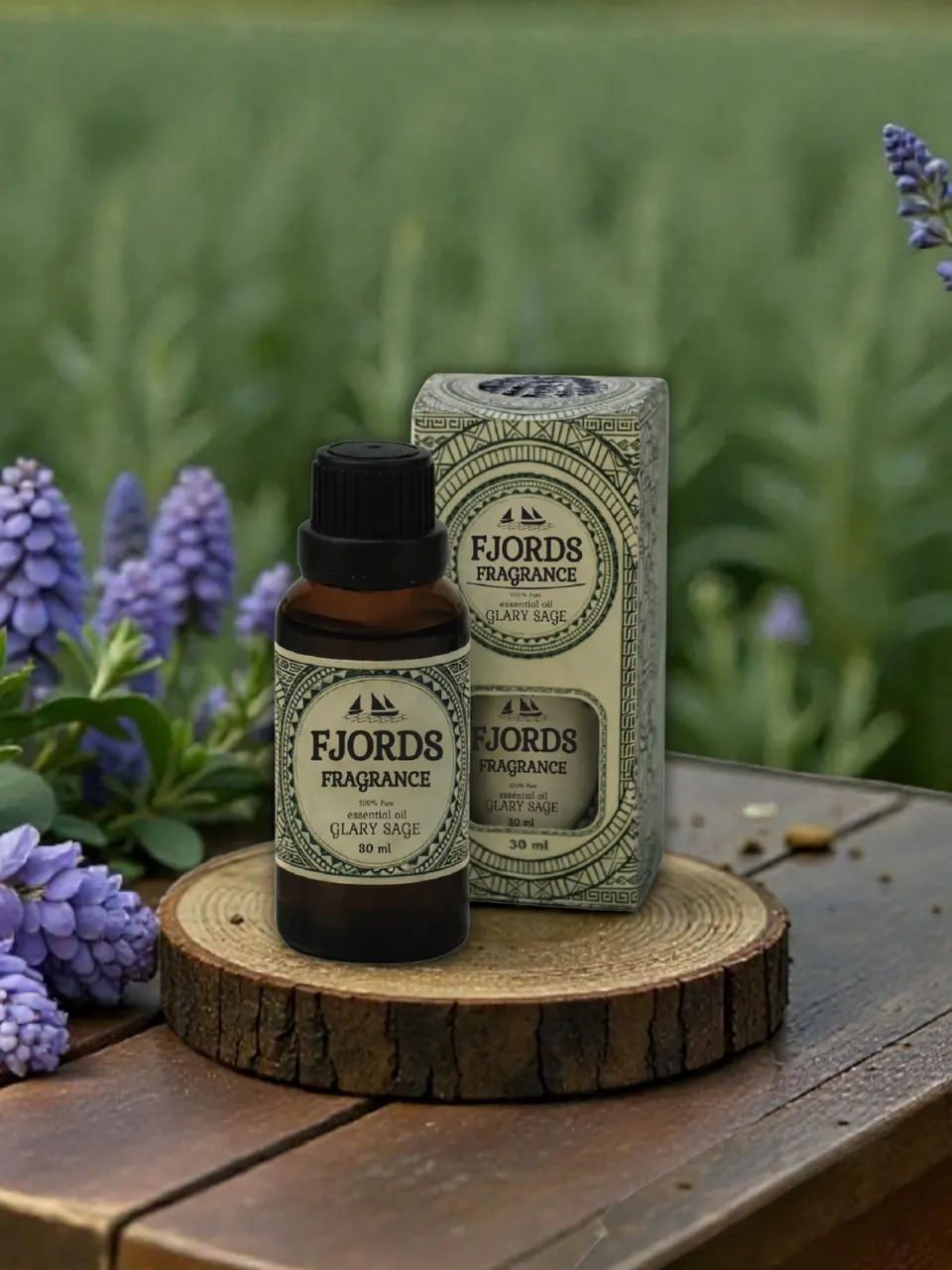
| Volume | 30 ml in a UV-protective dark glass bottle with dropper. |
| Origin | France, Bulgaria, or Russia, depending on the harvest. |
| Shelf Life | 4-5 years unopened; best within 2-3 years once opened. |
Storage and Quality
Clary sage keeps well by essential-oil standards, but its main component, linalyl acetate, slowly oxidises when exposed to air, light, and heat. Oxidation dulls the oil's sweetness and makes it more likely to irritate skin, so treat storage as part of quality. Keep the bottle tightly capped in a cool, dark cupboard - never inside the sauna itself, where heat cycles will age it quickly - and always in its dark glass bottle rather than decanted into plastic. Stored this way, an unopened bottle holds its character for 4-5 years; once opened, plan to enjoy it within 2-3. Our oil is 100% pure Salvia sclarea with no synthetic additives, dilution, or reconstitution, bottled by FJORDS FRAGRANCE OÜ.
Safety Information
- Pregnancy caution: Avoid clary sage throughout pregnancy. The oil carries a long-standing traditional caution for expectant mothers, and we take it at face value - choose a different oil for these months, and ask your midwife or doctor about any essential oil use while pregnant or breastfeeding.
- Never ingest: This oil is for aromatic and properly diluted topical use only.
- Dilute for skin: Keep topical use at around 2 percent in a carrier oil and patch test first. Stop if irritation appears.
- Deep relaxation: Many people find clary sage strongly calming, and traditional aromatherapy advice is not to combine it with alcohol and not to schedule driving straight after a heavy evening session.
- Children: Store out of reach, and do not use on or around young children without professional guidance.
- Pets: Many essential oils are hazardous to cats and dogs, and cats are especially sensitive. Diffuse only in ventilated spaces your pet can freely leave, never apply oils to animals, and ask your vet if you share a home with a sensitive pet.
- Honest framing: Clary sage is a comforting scent, not a treatment. It is traditionally valued for relaxation, but for health questions - sleep-related, hormonal, or otherwise - consult a specialist.
Frequently Asked Questions
Q: How is clary sage different from common sage?
A: Common sage (Salvia officinalis) smells sharper and more camphor-like and comes with stricter safety limits in aromatherapy. Clary sage (Salvia sclarea) is sweeter, nuttier, and softer, and is generally considered the gentler of the two - though it has its own cautions, most notably in pregnancy.
Q: Why is it called "clary" sage?
A: The name comes from the Latin clarus, meaning clear. Medieval herbalists called the plant "clear eye" because its gel-coated seeds were once used to sweep specks of dust from the eye.
Q: Can I use clary sage while pregnant?
A: No - we recommend avoiding it entirely during pregnancy, in line with the traditional caution attached to this oil. If you are pregnant or breastfeeding and unsure about any essential oil, ask your midwife or doctor before use.
Q: Can I pour it directly onto the hot sauna stones?
A: No. Always dilute 2-3 drops in about 500 ml of water first. Pure oil scorches on hot stones, can flash-ignite, and produces acrid smoke instead of pleasant steam.
Q: Does clary sage balance hormones or ease menstrual cramps?
A: It has a long folk reputation in both areas, which is why you will see such claims elsewhere. We will not repeat them as fact: an essential oil is a comforting scent, not a treatment. If you are dealing with hormonal or menstrual issues, please talk to a healthcare professional.
Q: Why do some people describe clary sage as "euphoric"?
A: "Euphoric" is an old aromatherapy label for this oil, probably owed to its warm, wine-like depth. In practice most people simply find it deeply relaxing, and experiences vary - treat it as a mood, not a medicine.
Q: Is clary sage safe to use around pets?
A: Treat it with care, as with most essential oils. Cats in particular process many oil compounds poorly. Diffuse only in ventilated rooms your pet can leave at will, never apply oil to an animal, and check with your vet if in doubt.
Q: How does clary sage compare to lavender for an evening sauna?
A: They share the same calming core chemistry, but lavender stays clean and floral while clary sage runs deeper, drier, and muskier. If lavender feels a touch too polite, clary sage is the next step - or blend them 1:2 for the best of both.