The Scandinavian Sauna Tradition - Why It Still Matters
The Nordic sauna still matters because it was never about heat alone. It is a weekly ritual of family, silence and cold water that has structured life in Finland, Sweden, Norway and Estonia for centuries, and in December 2020 UNESCO inscribed Finnish sauna culture on its Representative List of the Intangible Cultural Heritage of Humanity. Finland alone has roughly one sauna for every two people. Scent has always been woven into this tradition - birch leaves, wood smoke, tar, and today a few careful drops of essential oil in the water bucket. Here is what the tradition actually is, why it survived, and how to bring its scent culture into your own sauna honestly.
A Tradition Older Than the Countries Around It
Saunas predate written Nordic history. The earliest versions were pits dug into hillsides with heated stones; later came the smoke sauna, then the wood-fired room most people picture today. For most of that history the sauna was the cleanest, warmest room a family had - children were born there, the sick were cared for there - and etiquette still asks you to behave, as the Finnish saying goes, as you would in church.
That history explains what visitors often miss: in the Nordics the sauna is not a wellness product, it is infrastructure. Apartment buildings have shared saunas with booked family slots; the Finnish parliament has one. When something is that ordinary, it stops being a luxury and becomes a rhythm.
The Weekly Ritual
The classic pattern is the Saturday sauna. The stove is lit in the afternoon and the family goes in rounds - often grandparents, parents and children together, because the family sauna is a normal part of growing up, not an exception. Phones stay outside. Conversation is optional.
A session has a rhythm you can feel after one visit:
- Warm up: enter, sit, let the first sweat come.
- Löyly: water is thrown on the stones and the room fills with soft steam. This moment is the heart of the whole tradition - we unpack it properly in our guide to löyly, the Finnish steam, explained.
- Cool down: a lake, the sea, snow, or simply the porch.
- Repeat: two or three rounds, each one quieter than the last.
Nobody times it. The sauna is done when you feel done - one of the few places in modern life where that is the official rule.
Cabin and Lake Culture
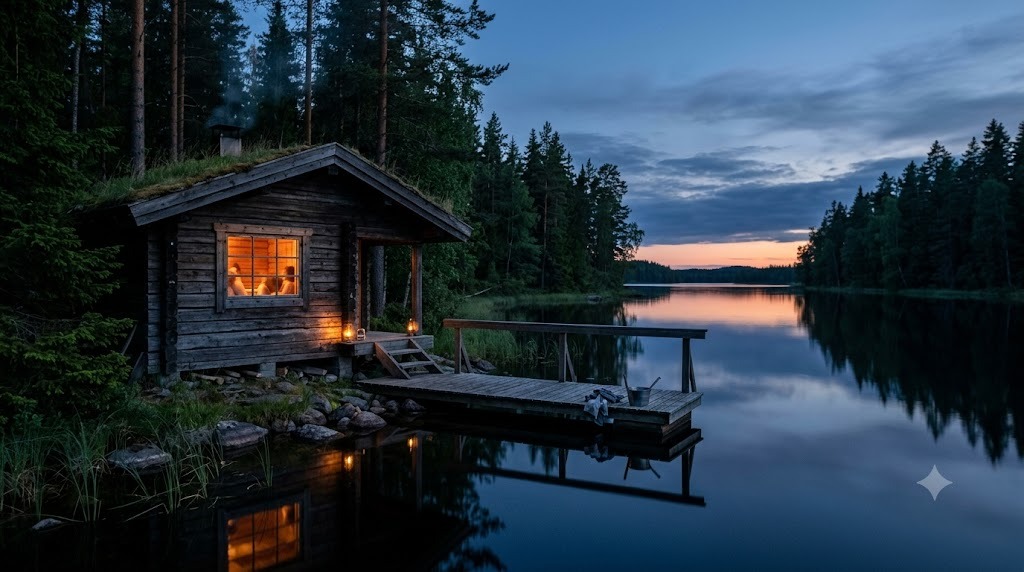
The summer cottage - mökki in Finnish, stuga in Swedish, hytte in Norwegian - is the other half of the tradition. Hundreds of thousands of these cabins sit on lakeshores, and at many of them the sauna was built before the cabin itself. The evening logic is simple: heat the sauna, swim, sit in the steam, swim again. The lake is not an accessory to the sauna; the alternation between hot steam and cold water is the experience, and warm spruce walls, lake water and birch are the smell most Nordic people would name if you asked what summer smells like.
What UNESCO Actually Recognised
In December 2020, UNESCO added sauna culture in Finland to its Representative List of the Intangible Cultural Heritage of Humanity. The listing is precise in an interesting way: it protects not the building but the living social practice - the bathing customs, the sense of peace and equality inside the room, and the traditions passed between generations.
Finland is not alone in that recognition. Estonia's Võromaa smoke sauna tradition received UNESCO status back in 2014 - an older, darker, more ceremonial cousin where the smoke itself is the signature scent. Our post on Estonian smoke sauna scents goes deep on how it smells and how to echo it with oils like cedarwood and pine.
How Scent Fits the Tradition
Scent was never an add-on in Nordic sauna culture - it was built in. The vihta (a whisk of fresh birch branches) releases a green, honeyed leaf scent when it meets steam; smoke saunas carry tar in their walls; even a plain modern sauna smells of heated spruce panelling. Essential oils are simply the contemporary way to take part in that tradition when you do not have a birch tree outside the door.
The method is the traditional one: scent the water, not the stones. Add drops to the bucket, stir, and ladle onto the kiuas as usual - neat oil on hot stones burns instantly and smells scorched. A sensible starting canon:
| Phase of the session | Traditional note | Oil to try | Drops per 500 ml water |
|---|---|---|---|
| Entry and first rounds | Forest, warm wood | Pine or spruce | 3-5 |
| Deep heat, big löyly | Sharp, clearing steam | Eucalyptus or peppermint | 2-3 |
| Last round, wind-down | Soft, calm finish | Lavender or cedarwood | 3-5 |
Eucalyptus in big löyly is the closest thing to a modern Nordic standard - the steam feels bigger and the room smells scrubbed clean. To be clear: these are scents, not treatments. Eucalyptus is traditionally valued for that airy, open feeling in the steam, but nobody should promise you more than an honest aroma. For exact amounts and safety notes, see our essential oil dosage guide for sauna; if you are torn between the classic notes, birch, pine or eucalyptus settles it. One firm rule: only pure essential oils belong in sauna water - fragrance oils do not. When small children share the sauna, leave eucalyptus, peppermint and camphor out and use plain water. If you are pregnant or have asthma or epilepsy, ask a doctor before using essential oils.
Bringing the Tradition Home
You do not need a lake or a hundred-year-old smoke sauna to practise the tradition honestly. What you need is the shape of the ritual:
- Make it weekly. Same evening, every week. The regularity is the tradition.
- Invite people. Family or friends, in rounds.
- Keep phones out. Non-negotiable in every Nordic sauna.
- Scent one phase, not all of them. One oil per session keeps the ritual legible. Our complete guide to sauna scents maps the full range, and the scent finder quiz will pick a starting oil for you in a minute.
- End cold. A cold shower is a perfectly respectable lake substitute. If you have a heart condition or high blood pressure, cool down gradually and ask your doctor before trying cold plunges.
If your setup is an infrared cabin, the water-bucket method does not apply - use our infrared sauna essential oils guide instead. Whichever route you take, all twenty-four single oils live in the shop, many with their own in-depth guide, such as the eucalyptus essential oil guide.
FAQ
Q: Why did UNESCO list Finnish sauna culture?
A: In December 2020, UNESCO inscribed sauna culture in Finland on its Representative List of the Intangible Cultural Heritage of Humanity - recognising the living practice of bathing customs and generational tradition, not the building itself.
Q: How often do people in the Nordics actually take a sauna?
A: Weekly is the cultural baseline, with Saturday evening as the classic slot. Many go far more often - daily is unremarkable in Finland.
Q: Is it authentic to use essential oils in a traditional sauna?
A: Scenting the steam is as traditional as the sauna itself - birch whisks, tar and smoke came first; oils are the modern continuation. Dilute drops in the water bucket and ladle it over the stones: 3-5 drops per 500 ml for mild oils like pine or lavender, 2-3 for eucalyptus or peppermint, only 1-2 for intense oils like camphor. Never pour neat oil onto the stones, and never ingest any essential oil.
Q: What is the difference between the Finnish sauna and the Estonian smoke sauna?
A: The Finnish tradition centres on the wood-fired or electric sauna and its löyly; the Estonian Võromaa smoke sauna - UNESCO-listed in 2014 - has no chimney, so smoke seasons the room and gives it a deep tar character. Our Estonian smoke sauna scents post covers it in detail.
Q: Do I need a lake or snow for the cool-down?
A: No. The tradition asks for contrast, not geography. A cold shower or five minutes outside does the same job the lake does at a Nordic cabin.