Description
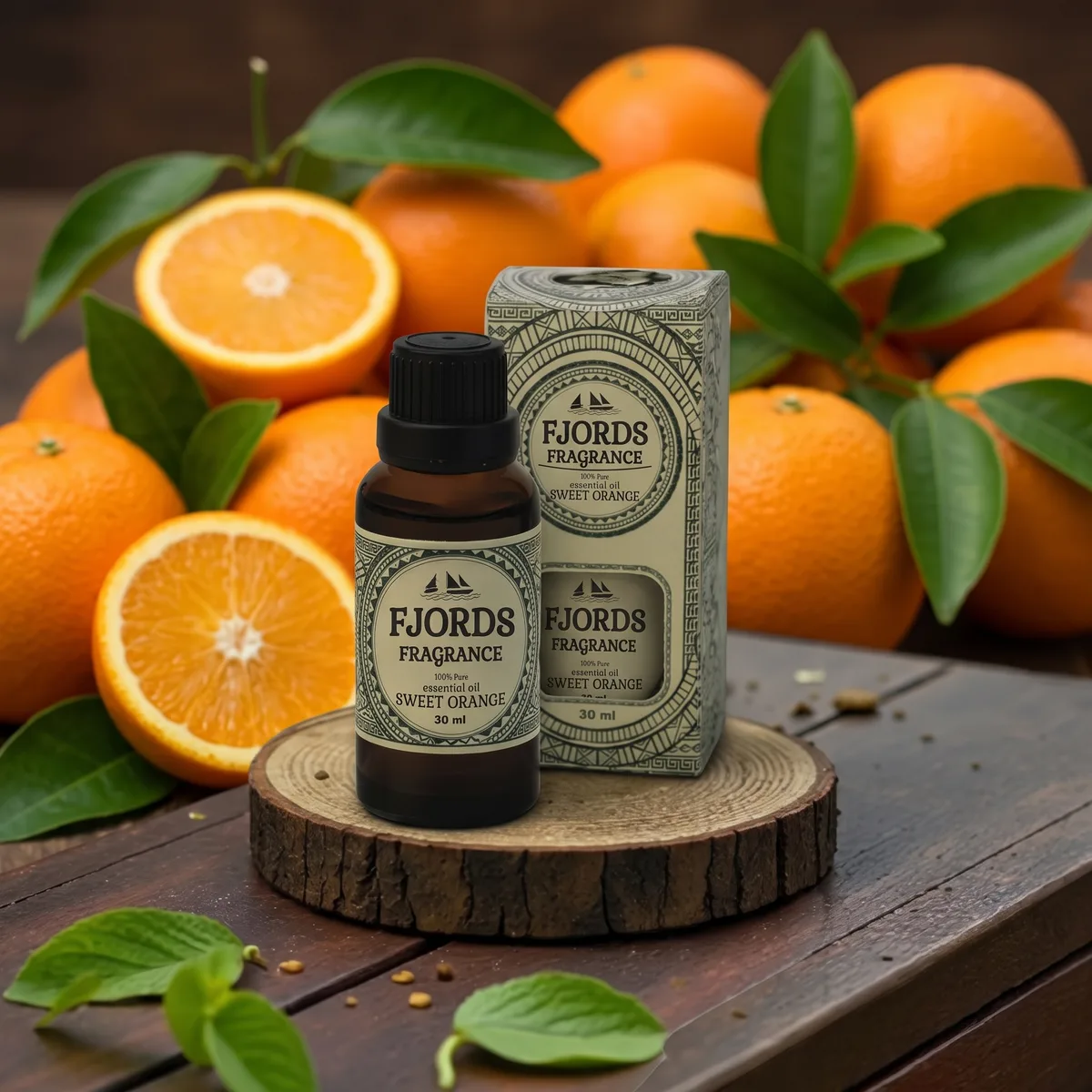
Sweet orange essential oil is cold-pressed from the peel of Citrus sinensis, the ordinary eating orange. That method matters: unlike almost every other oil in this range, it is not steam-distilled. The peel is mechanically pressed and the oil released from the tiny glands you can see when you bend a piece of zest toward a candle flame. Most of the world's supply is a by-product of the juice industry, which makes this one of the few genuinely abundant natural aromatics.
That abundance is its charm rather than its weakness. Sweet orange is the most immediately likeable scent there is: no one needs it explained, no one finds it challenging, and almost everyone smiles slightly when a room fills with it. It has no ancient ceremonial history to draw on and it needs none, and like every oil here it treats and cures nothing.
Chemically it is dominated by limonene, often above ninety percent, with small amounts of myrcene and linalool doing the rest of the work. Limonene is light, volatile and quick to oxidise, which explains both the bright first impression and the short life in the bottle.
Scent Profile
Sweet orange opens exactly as promised: juicy, sweet, sunny, unmistakable. There is no bitterness and no perfume complexity behind it, just clean fruit. The dry-down is short, which is its one real limitation as a room scent and the reason it is so often blended.
Against the other citruses in our range it is the friendliest. Lemon is sharper and more astringent, bergamot more perfumed and grown-up. Sweet orange is the one children and guests recognise instantly.
In the Sauna
Sweet orange is a mild oil that fades faster than most:
- 1. Prepare the water first. About 500 ml of warm water in the bucket.
- 2. Add 3-5 drops of sweet orange oil. Use the upper end here rather than the lower; it is gentle and it disappears quickly.
- 3. Stir well so the oil disperses instead of floating.
- 4. Ladle small amounts over hot stones. The burst is immediate and lovely and it does not last long.
- 5. Repeat as the session goes on, every 10-15 minutes, or blend it over a heavier base so the scent holds.
Never pour undiluted oil onto the stones. Neat oil is flammable and can flash on a hot heater, and scorched citrus smells like burnt marmalade. Always dilute in water. The dosage guide covers the amounts, and the complete sauna scents guide compares it with the rest of the range.
At Home
- Diffuser. 3-5 drops. The most reliable way to make a kitchen, hallway or sickroom feel cared for.
- Mornings and dark afternoons. Citrus is the obvious answer to a grey northern winter, and there is no shame in the obvious answer.
- Cleaning. Limonene is a genuinely good solvent, which is why so many cleaning products borrow the smell. A few drops in a bucket of warm water works on kitchen surfaces.
- Body oil. About 2 percent in a carrier, roughly 12 drops per 30 ml. Sweet orange is the citrus least likely to cause trouble in sunlight, though the freshness rules below still apply. See the carrier oils guide.
Blending Guide
Sweet orange is a top note that needs company to last. Ratios are by drops.
| Partner oil | Suggested ratio | The mood it makes |
|---|---|---|
| Cedarwood | 1 : 1 | Orange over warm wood - the blend that makes a cold house feel lived in. |
| Spruce | 1 : 1 | Forest and fruit, the most festive pour in the range without being a Christmas cliche. |
| Lavender | 1 : 1 | Sweet and calm at once, one of the easiest blends to get right. |
| Patchouli | 3 : 1 orange to patchouli | Bright fruit on dark earth. Strange on paper, excellent in a room. |
| Clary sage | 2 : 1 orange to clary sage | Fruit with a herbal shadow, more interesting than orange alone. |
All partners come from our own range.
Key Characteristics
| Feature | Description |
|---|---|
| Aroma Profile | Sweet, juicy and sunlit - clean orange peel with no bitterness and no perfume edge. |
| Intensity | Mild and short-lived - bright on arrival, gone sooner than heavier oils. |
| Composition | 100% pure Citrus sinensis peel oil, cold-pressed rather than distilled. |
| Volume | 30 ml in UV-protective dark glass with a dropper. |
| Origin | Cold-pressed from orange peel, largely a by-product of the citrus juice harvest. |
| Shelf Life | 1-2 years unopened, best within about a year of opening - citrus peel oils are the shortest-lived in any range, so buy small and use it. |
Storage & Quality
Limonene oxidises faster than almost any other common aromatic, and oxidised citrus oil is a well-documented cause of skin sensitisation. Keep this bottle closed, cool and dark, consider the refrigerator if your home is warm, and do not keep it for years out of thrift. A bottle that smells flat, waxy or faintly of turpentine has gone, and its safety profile has changed along with its smell.
Quality is rarely the problem with sweet orange: it is cheap enough that adulteration is pointless. Freshness is the whole story.
Safety Information
- Never take it internally. Orange juice and orange oil are not the same thing, and the oil is a concentrate.
- Sunlight. Several citrus oils make skin react to sunlight, notably bergamot and lemon. Sweet orange is generally regarded as an exception, but if you use it on skin and then sit in strong sun, keep the dilution low and watch how your skin behaves.
- Fresh oil only. Oxidised citrus sensitises skin. This is the practical reason for the short shelf life above.
- Dilute for skin. Around 2 percent in a carrier, patch tested.
- Pets. Citrus oils are poorly tolerated by cats in particular. Keep animals out of a scented sauna and out of a diffused room they cannot leave.
- It is a scent, not a treatment. Citrus is widely described as uplifting and many people find it so. Take health questions to a qualified professional.
Frequently Asked Questions
Q: Is sweet orange oil distilled?
A: No, it is cold-pressed from the peel. That is why it smells so much like the fruit itself; distillation would change its character considerably.
Q: How many drops go in a sauna bucket?
A: 3-5 drops in about 500 ml of water. It is gentle and it fades quickly, so the upper end of the range is reasonable here.
Q: Does sweet orange cause sun sensitivity like bergamot?
A: It is generally considered non-phototoxic, unlike bergamot, lemon, lime and bitter orange. Use a low dilution anyway if you are going into strong sun.
Q: Why does my orange oil smell flat?
A: It has oxidised. Citrus peel oils are the shortest-lived aromatics there are; a year or two is a realistic working life, less in a warm room.
Q: Is it safe for children?
A: It is among the gentler oils, but hot scented steam is not the place for small children whatever the oil. Diffuse lightly in a ventilated room instead.
Q: What is the difference between sweet and bitter orange?
A: Different species and different oils. Bitter orange, Citrus aurantium, is sharper and does carry a sun-sensitivity caution. Ours is the sweet one.
Q: What blends well with sweet orange?
A: Woods and conifers above all, then lavender and clary sage. The blending table above gives five ratios from our own range.
Q: Can I use it to clean with?
A: Yes, and people have for a long time. A few drops in warm water works on kitchen surfaces; test on a small patch of any finished wood first.