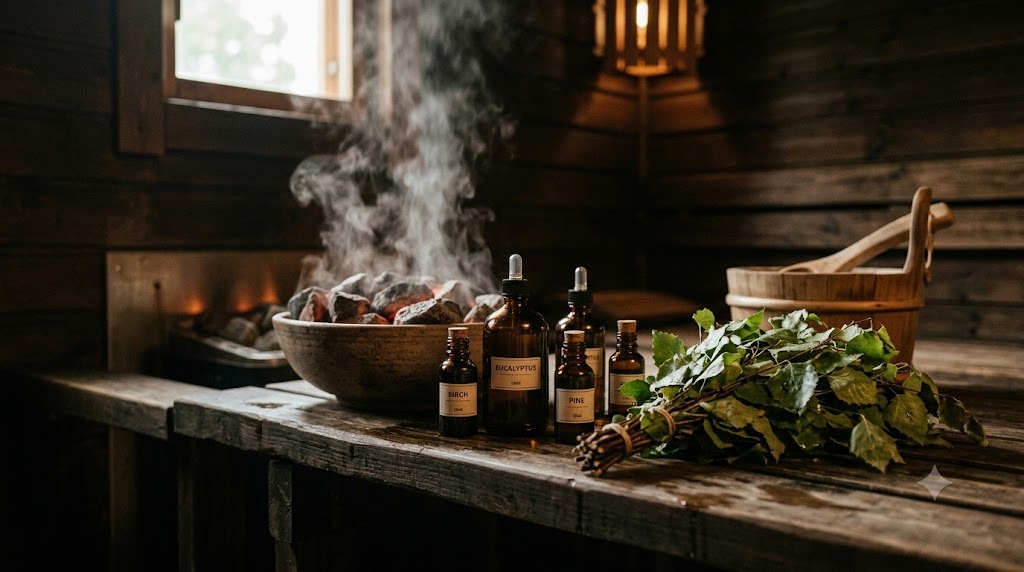
If you only keep one essential oil next to the sauna bucket, make it eucalyptus - it is the scent most people mean when they say "sauna smell". After that, the honest shortlist is short: pine and spruce when you want the forest, lavender for the evening wind-down, cedarwood for quiet warmth, and bergamot or peppermint when you want the session bright and sharp. Below is the full ranking, why each oil earns its place, and exactly how many drops to use - always stirred into water first, never dripped neat onto the stones.
The shortlist at a glance
| Oil | Drops per 500 ml of water | Character | Best moment |
|---|---|---|---|
| Eucalyptus | 2-3 | Sharp, cool, classic | Any session |
| Pine | 3-5 | Resinous, deep forest | Long, slow sessions |
| Lavender | 3-4 | Soft, floral, calm | Evening |
| Spruce | 3-5 | Green, bright forest | Weekend daytime |
| Cedarwood | 3-4 | Dry, warm, woody | Blending, quiet sessions |
| Bergamot | 3-4 | Citrus-floral, bright | Social saunas |
| Peppermint | 2-3 | Icy, intense | Morning |
The ranking, with honest reasons
1. Eucalyptus - the definitive sauna oil
There is a reason every public sauna from Helsinki to Tallinn smells faintly of eucalyptus. The moment the steam rises, that sharp, cooling note makes each breath feel bigger and cleaner - a sensation, not a treatment, but a remarkably convincing one. It is also strong: stick to 2-3 drops per 500 ml of water, less than you would use of almost anything else. If you are torn between the classic Nordic contenders, our comparison of birch, pine and eucalyptus in the sauna settles it session by session, and the eucalyptus guide covers the oil beyond the sauna door.
2. Pine - the forest, distilled
Pine is the oil for long, unhurried sessions. It is resinous and grounding rather than sharp, and it lingers in the hot air longer than citrus or floral oils do, so one ladle carries you further. Use 3-5 drops per 500 ml. If eucalyptus is the sauna's espresso, pine is the slow pot of coffee - see the pine guide for its full character.
3. Lavender - the evening sauna
Lavender is the most forgiving oil on this list. It is gentle enough for people who find eucalyptus aggressive, it blends with practically everything, and it has been traditionally valued for winding down at the end of the day - again, a scent, not a therapy. 3-4 drops per 500 ml gives a soft, rounded steam. The lavender guide has pairing ideas if you want to build an evening blend around it.
4. Spruce - pine's brighter sibling
Where pine is deep and resinous, spruce is greener and lighter - closer to crushed needles than to sap. It is arguably the most authentically Nordic scent you can pour, and it takes 3-5 drops per 500 ml happily. For the tradition it belongs to, read our piece on Estonian smoke sauna scents, where conifer notes are the whole point.
5. Cedarwood - quiet warmth
Cedarwood never announces itself the way eucalyptus does, and that is its strength. Dry, warm and woody, it deepens the smell of the sauna itself rather than sitting on top of it, which makes it the best base note for blends. 3-4 drops per 500 ml on its own, or 2 drops under 2 drops of something brighter.
6. Bergamot - the bright one
Bergamot is citrus with a floral edge, and it makes a sauna feel social rather than meditative. Two honest caveats: it fades in high heat faster than the woods do, so add it to a fresh ladle mid-session, and it is photosensitising on skin - if any oil-scented water has touched you, shower well before sunbathing. 3-4 drops per 500 ml. The bergamot guide covers the photosensitivity point in detail.
7. Peppermint - the wake-up call
Older lists (including our own) put rosemary in this slot. We do not carry rosemary, and honestly peppermint does the clarifying morning job better: an icy, unmistakable blast that pairs strangely well with 80-degree air. It is very easy to overdo - 2-3 drops per 500 ml, no more, and keep it away from your eyes and face when towelling off.
How to use oils in the sauna
- Fill your ladle bucket with about 500 ml of clean water.
- Add the drops for your chosen oil (see the table above) and stir - oil floats, so swirl before every pour.
- Pour over the stones in two or three stages rather than all at once; the scent develops with each wave of steam.
- Never drip essential oil directly onto hot stones. It flash-burns, smells acrid instead of aromatic, and can stain the stones.
- Ventilate between sessions so the next round starts clean.
The pour itself is half the craft - our explainer on loyly, the Finnish steam ritual, covers timing and technique. And if you only bookmark one reference, make it the essential oil dosage chart for the sauna, which lists safe drop counts for every oil we stock.
Oils that need extra care - or a different room
Camphor and oregano are the two oils that most often ruin a session: both are limited to 1-2 drops per 500 ml, and even then they dominate. Neither should ever be ingested. Tea tree is capped at 2-3 drops and comes with a firm household rule: it is toxic to cats and dogs, and many essential oils are unsafe around cats generally, so keep pets out of the sauna area and away from the bucket. If you are tempted by a cheap "sauna fragrance" bottle instead, read whether fragrance oils can go in saunas first - the short answer is that most should not. And if your sauna is infrared, the water-and-stones method does not apply at all; we cover the alternatives in essential oils for infrared saunas. When small children share the sauna, leave eucalyptus, peppermint and camphor out and use plain water. If you are pregnant or have asthma or epilepsy, ask a doctor before using essential oils.
FAQ
Q: Can I mix two oils in one ladle?
A: Yes, and some of the best sauna scents are blends - pine with a drop of bergamot, or cedarwood under lavender. Count the total drops against the limit of the strongest oil in the mix: a eucalyptus blend still caps at 2-3 drops in total per 500 ml.
Q: My bucket holds more than 500 ml - do I add more drops?
A: Scale roughly with the water: a full litre takes about double the drops. When in doubt, start at the low end and add to the next ladle - you can always intensify, never un-pour. The dosage guide has the full chart.
Q: Do sauna oils treat colds or anxiety?
A: No. Eucalyptus feels opening and lavender is traditionally valued for calm, but these are scents, not treatments, and nothing here replaces medical advice - if you have a health concern, consult a specialist. And never ingest any essential oil, in the sauna or anywhere else.
Q: Which oil should I start with if I am new to this?
A: Eucalyptus if you want the classic experience, lavender if you want the gentle one. If you would rather be matched to a scent than guess, take the two-minute scent finder quiz.
For the wider map - blending, seasons, traditions and every oil we cover - start with the complete guide to sauna scents, or browse the full range in the shop.