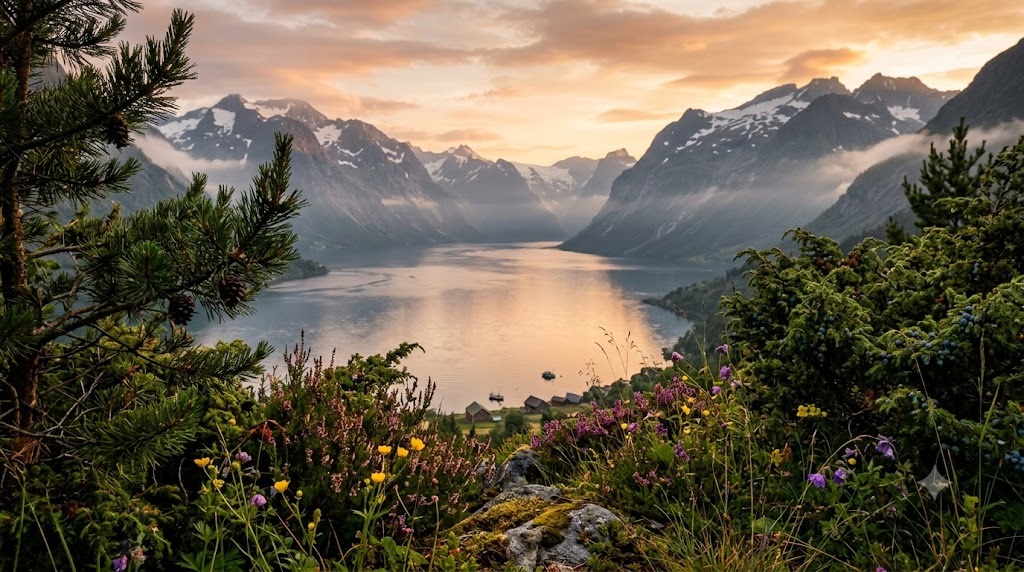
The Nordic landscape reads like a scent map with four regions: the conifer forest (pine, spruce, cedarwood over a damp floor), the clearings (peppermint, eucalyptus, cool herbs), the coast (mineral, clean, wind-scrubbed) and the brief bright light of summer (citrus and soft florals). Every oil in our collection belongs to one of those regions. This post walks the map from treeline to tide line, names the pure single oil that carries each note, and shows how to rebuild the landscape at home - no perfume tricks, nothing synthetic.
Fjords Fragrance began with a place rather than a product. The deep inlets of the Nordic coast - dark water, low light, forests running right down to the shore - have a scent of their own: cool, green, resinous and clean. The collection is an honest attempt to bottle that feeling one note at a time; where a note must be borrowed from a warmer climate, we say so.
The forest: resin, timber and the dark floor
Walk into a northern coniferous forest on a still afternoon and the air is unmistakable - sharp, sweet and slightly balsamic. That is resin warming on bark. Beneath it is the smell most people only notice when they kneel: needles breaking down into dark, damp earth.
- Pine essential oil is the brightest of the forest notes - the open-air smell of the canopy itself. If you want the walk, start here; see the pine guide.
- Spruce essential oil is softer and rounder, closer to cut boughs stacked by a door - the tree at arm's length rather than the forest at large.
- Cedarwood essential oil sits underneath them both: dry, warm and woody, the scent of sawn timber and quiet cabins - the note that makes a forest blend feel inhabited.
- Patchouli essential oil is our forest floor. The plant is tropical, not Nordic - we are open about that - but nothing else distilled comes as close to wet humus and turned earth after rain. One drop under the conifers darkens the whole picture.
The clearings: cold green and crushed herbs
Between the trees the light changes and so does the smell - bruised leaves, cold dew, grasses going over in the sun. Three oils carry it. Peppermint essential oil brings the cold snap of a crushed leaf on a chilly morning. Eucalyptus essential oil adds a camphor-fresh edge that reads like moving air. Clary sage essential oil rounds them out with dry hay and a soft, nutty herbaceousness - a borrowed plant, chosen for the note it carries, not its passport. Together they read like a cool morning after rain. At the hot far edge of the herb family sits oregano essential oil - Mediterranean, fierce, 1-2 drops at most and never ingested.
The coast: salt, stone and wind
An honest problem: nobody can distil the sea. Salt itself has almost no smell - what you notice at the tide line is iodine from drying wrack, cold stone, air scrubbed clean by wind. So we approach the coast sideways, with oils that carry cold minerality rather than literal brine.
Eucalyptus does double duty here - diffused lightly, it smells more like sea wind than any plant (more in the eucalyptus guide). Tea tree essential oil is clean and faintly medicinal, close to the tide line itself - but it is toxic to cats and dogs, so keep it out of homes with pets. Camphor essential oil is the coldest, most mineral note we carry - wet rock in scent form, and the strongest: 1-2 drops is always enough, and it must never be ingested (true of every oil on this page).
The light: citrus and midsummer flowers
Even in the north there is brightness - it simply arrives all at once, in the June weeks when the light barely leaves the sky. Lemon and bergamot essential oil give the sunlit lift; both are photosensitising on skin, so keep them for the diffuser rather than a pre-sun body blend. For the floral heart of a light evening we reach for lavender (see the lavender guide), rose, neroli and jasmine - soft, unhurried scents for hours when the sky refuses to darken.
Reading the map at a glance
| Region | The note | The oils | Diffuser starting point |
| Forest | Resin, timber, damp earth | Pine, spruce, cedarwood, patchouli | 3-5 drops total |
| Clearings | Cold green, crushed herb | Peppermint, eucalyptus, clary sage | 3-4 drops total |
| Coast | Mineral, clean, wind-scrubbed | Eucalyptus, tea tree, camphor | 2-3 drops (camphor 1-2) |
| Light | Citrus, soft florals | Lemon, bergamot, lavender, rose, neroli, jasmine | 3-5 drops total |
How to build your own fjord
The mistake most people make is blending too early. Learn the single notes first.
- Start with one region and one oil. Live with it in the diffuser (3-5 drops) for a week.
- Pair within a region before you pair across. Pine plus cedarwood is a forest; pine plus rose is a gamble.
- Add a second region in small strokes. A forest base takes one drop of lemon like a shaft of light through trees.
- Keep the strong oils on a short leash. Peppermint, eucalyptus, camphor and patchouli can each take over a blend with one extra drop.
For skin, keep any blend at around 2% in a carrier oil. For a bath, always dissolve the essential oil in a carrier oil or a proper solubilizer first - salt and milk do not disperse essential oils, and undissolved drops meet your skin at full strength. Keep peppermint, eucalyptus and camphor away from infants and young children. If you are pregnant or have asthma or epilepsy, ask a doctor before using essential oils.
The sauna crossover
The same map works in the sauna, where the Nordic landscape idea is oldest and most at home. Mild oils such as pine, spruce, cedarwood and lavender go into the ladle water at 3-5 drops per 500 ml; sharper oils - eucalyptus, peppermint, tea tree - at 2-3 drops; camphor at 1-2 at most. Always into the water, never neat onto the stove. Our complete sauna scent guide covers the method, the dosage guide covers the numbers, birch, pine or eucalyptus settles the classic debate, and what löyly actually is explains the steam itself.
Why pure single oils, and nothing synthetic
Every bottle in the range is a 100% pure single-plant oil (jasmine, strictly speaking, is an absolute) - no fillers, no synthetic fragrance, no dilution you did not ask for. That is what makes the scent map possible. A synthetic forest accord is one fixed picture you can never take apart; single oils are honest raw notes you can combine, rebalance and learn from, the way you learn a landscape by walking it in different weather.
One more piece of honesty: these are scents, not treatments. Conifer and lavender notes have been traditionally valued in Nordic bathing culture for how they make a room feel, and that is the whole claim. If you are managing a health condition, consult a specialist rather than a fragrance company.
FAQ
Q: Which single oil smells most like a Nordic forest?
A: If you only take one, take spruce. Pine is the forest's air, cedarwood its timber; spruce is the tree itself.
Q: Can I use these landscape blends in the sauna?
A: Yes - into the ladle water, never onto bare stones. Mild oils 3-5 drops per 500 ml, eucalyptus and peppermint 2-3, camphor 1-2; the sauna dosage guide has the full table.
Q: Are these oils safe around pets?
A: Tea tree is toxic to cats and dogs, and many essential oils are unsafe around cats in particular. Diffuse only in ventilated rooms your animals can leave, and ask a vet first.
Q: Where should I start if I cannot choose a region?
A: Take the scent finder quiz - it maps your preferences onto the landscape and suggests a first oil. Or browse the whole map in the collection.