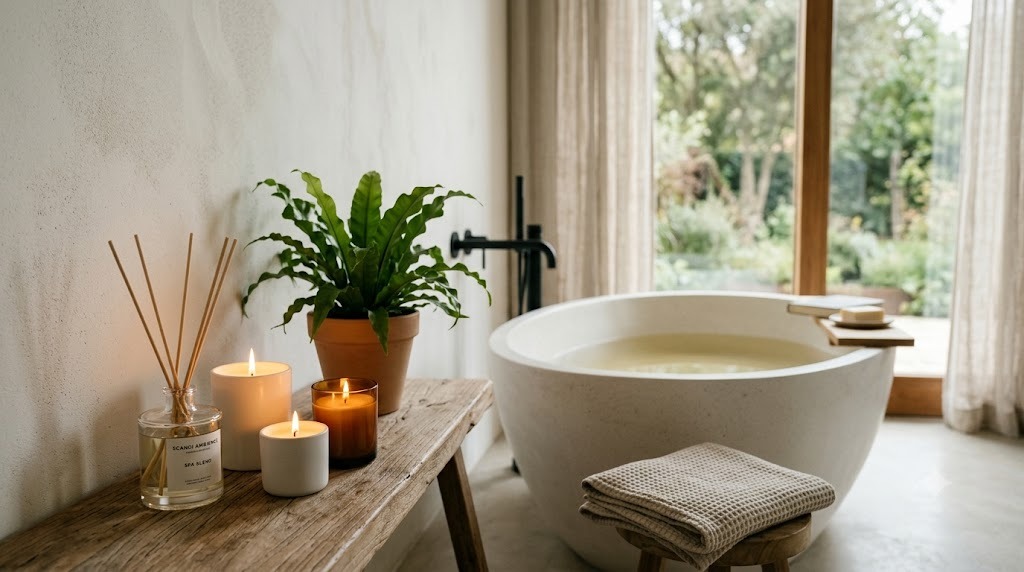
How to Create a Modern Home Spa with Essential Oils
You do not need a spa membership to have a proper spa evening. You need a warm bathroom, 30-45 undisturbed minutes, and essential oils used at the right dose - always dissolved in a carrier oil or bath solubilizer before they touch the water, never dripped in neat. Below is the whole ritual in order: preparing the room, the bath itself, a shower steam variant if you have no tub, scented towels and linen, lighting and quiet, and aftercare - with exact drop counts at every step. If you are not sure which oil suits you, the scent finder quiz narrows it down in two minutes.
Step 1: Prepare the Bathroom (10 Minutes Before)
A spa is mostly a warm room with nothing demanding your attention. Run the shower on hot for 3-5 minutes with the door closed to pre-warm and humidify the space, or use a heater if your bathroom runs cold. Hang a towel over the radiator or a heated rail so it is warm when you get out. Clear the countertop - visual clutter reads as noise. Bring a large glass of water; a warm bath dehydrates you faster than you notice.
Then put your phone in another room, physically. A silenced phone within reach is still a phone within reach.
Step 2: The Bath Ritual
Fill the tub with warm water, around 37-38 degrees C - warm enough to relax into, not so hot that you are done in ten minutes. While it fills, prepare the oil mixture.
The one rule that matters: essential oils do not dissolve in water. Salt does not disperse them, and neither does milk - both are persistent myths. Undiluted drops simply float on the surface and then sit on your skin at full strength, which is exactly how bath oils end up irritating people. So dissolve first: stir 3-5 drops of essential oil into a tablespoon (15 ml) of carrier oil - jojoba, sweet almond, fractionated coconut - or a purpose-made bath solubilizer, then pour the mixture into the full tub and swirl it through. For strong oils such as eucalyptus or peppermint, use 2-3 drops total instead.
Bath Blends That Work
| Mood | Blend (total drops, dissolved in 1 tbsp carrier) |
| Wind-down evening | 3 lavender + 2 clary sage |
| Bright and citrusy | 3 bergamot + 2 lemon (see sun note below) |
| Cooling, after exercise | 2 eucalyptus + 1 peppermint |
| Romantic | 3 rose + 2 jasmine or neroli |
| Forest quiet | 3 cedarwood + 2 pine or spruce |
One blend per bath. Sun note: bergamot and lemon are photosensitising - after a citrus bath or citrus body oil, keep that skin out of direct sun for 12-18 hours.
Step 3: No Tub? The Shower Steam Variant
Steam carries scent beautifully - the same principle as Finnish löyly, where water hits hot stones and rises as fragrant vapour (how löyly works). In a shower you borrow the trick with a washcloth: put 3-4 drops of a mild oil - or 1-2 drops of eucalyptus or peppermint - on a damp washcloth or a small dish and set it on the shower floor in a corner, out of the direct spray. Hot water lifts scented steam for five to ten minutes.
Do not drip oil straight onto the shower floor: it makes the surface slippery and puts neat oil under your feet. And if steam plus scent turns out to be your favourite part of all this, you are describing a sauna habit - start with the complete guide to sauna scents, keep the sauna dosage chart handy, and settle the classic debate in birch, pine or eucalyptus.
Step 4: Towels and a Simple Linen Spray
Warm towels are half the spa effect and cost nothing. The other half is scented fabric. Make a linen spray: in a 100 ml spray bottle, combine water, one teaspoon of solubilizer (or 20 ml of unflavoured high-proof alcohol), and 15-20 drops of essential oil. Lavender suits bedding; cedarwood or patchouli gives towels a quiet, woody depth. Shake before every use, mist from about 30 cm, and let the fabric dry before it touches skin. Never spray pet bedding.
Synthetic fragrance oils can scent room-only textiles, but they follow different rules from essential oils - the distinction is explained in can fragrance oils go in saunas, and the short answer applies at home too: know what you are heating and what touches skin.
Step 5: Lighting, Quiet, and the Diffuser
Overhead light off. A candle or two, or a dim warm lamp, is enough - keep any flame well away from oil bottles and the linen spray, since essential oils are flammable. Silence is ideal; failing that, something instrumental at low volume.
Run a diffuser with 3-5 drops in the room you will rest in afterwards rather than in the bathroom, which is already scented. Stay in the same scent family as your bath blend and keep it to one or two oils - layering three scented things at once stops being a spa and starts being a perfume counter.
Step 6: Aftercare
Get out slowly, pat dry, and apply a body oil while skin is still slightly damp - it absorbs quickly after warm water. Keep the dilution around 2 percent: 4 drops per 10 ml (two teaspoons) of carrier oil. Lavender is the safe default; rose feels more indulgent. Then drink your water and stay horizontal for 15 minutes. The rest is where the relaxed feeling actually settles in - skip it and you have just had a nice wash.
Safety: The Short List
- Nothing is ever ingested. Not a drop, not in tea, no matter what a label claims.
- Bergamot and lemon are photosensitising on skin - no direct sun for 12-18 hours after use.
- Tea tree is toxic to cats and dogs - do not use it in a home with pets - and many oils are risky around cats generally. With other oils, ventilate, leave the door open so pets can leave, and never apply oils to an animal.
- Camphor and oregano are not home-spa skin oils. Experienced sauna users measure them at 1-2 drops per 500 ml of water; they have no place in a bath blend.
- A scent is a scent, not a treatment. If you are pregnant, have a skin condition, or any health concern, consult a specialist before using essential oils. The doses here are for adults: do not use peppermint or eucalyptus in a bath or shower steam for infants and young children.
FAQ
Q: Can I drip essential oil straight into the bathwater?
A: No. Oil and water do not mix, so undiluted drops float and can irritate skin on contact. Dissolve every drop in a tablespoon of carrier oil or a bath solubilizer first - and remember that salt and milk do not do this job.
Q: How many drops for a full bath?
A: 3-5 drops of a mild oil like lavender, rose or cedarwood; 2-3 drops of strong oils like eucalyptus, peppermint or tea tree. Always pre-dissolved, never neat.
Q: Is bath dosing the same as sauna dosing?
A: Close but not identical. Sauna water takes 3-5 drops of mild oils per 500 ml, 2-3 of eucalyptus or peppermint, and only 1-2 of camphor, oregano or cinnamon - the full breakdown is in the sauna dosage guide.
Q: How often should I do the full ritual?
A: Once or twice a week keeps it special and is gentle on skin. The shower steam variant is mild enough for daily use at 2-4 drops.
Q: Which oil should I buy first?
A: Lavender - it works in the bath, the diffuser, the linen spray and the body oil, and it is hard to overdo (see the full lavender guide). If lavender is not your scent, take the scent finder quiz or browse all 24 oils in the shop.